|
|
Last Modified on Jan 05, 2025
Driving while intoxicated (DWI) is a crime that can have lasting effects on your future if you are arrested and charged. You may feel that having a couple of drinks and heading home is no big deal. If you are pulled over and tested, the police may feel otherwise. After being arrested for a DWI, it is important that you understand Texas DWI laws and penalties, then speak to a Houston, TX DWI lawyer.
Hire a DWI Lawyer
Even if this is your first offense, the penalties for a DWI can be severe. You need to hire a DWI lawyer who can review your case and determine possible legal defense strategies. At Greco Neyland, PC, our team is familiar with Texas DWI laws and how they could affect your case.
DWI Rates in Texas
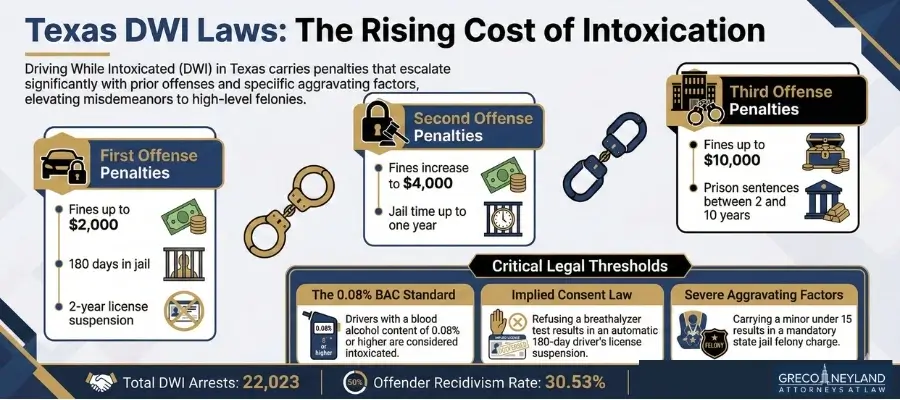
During the third quarter of 2024, the Texas Department of Public Safety recorded 22,023 DWI arrests. Of those arrests:
- 6,723 had a previous DWI arrest
- 30.53% recidivism rate for DWI offenses
- 531 DWI convictions
- 157 offenders convicted for DWI had a previous DWI conviction
- 29.57% conviction recidivism rate for DWI offenses
If you are facing DWI charges, your case is heard in the county in which you reside. Misdemeanor charges are heard in County Criminal Courts, while felony charges are heard in Criminal District Courts. Some counties have specific DWI courts that may hear cases.
If you are facing a license suspension, your case is heard by the State Office of Administrative Hearings. The agency has the authority to permit a 40-day extension of driving privileges when a suspension is challenged.
What Happens if I Am Pulled Over for a DWI in Texas?
Texas state law prohibits the operation of a motor vehicle while the driver is intoxicated or under the influence of drugs. The penalties for being caught driving a vehicle while intoxicated can be severe, especially if you are a repeat offender. An experienced DWI lawyer can help you figure out your most effective defense and provide you with any options you may have.
When you are pulled over for a suspected DWI, your interaction with the police should likely go through a predictable route. If you notice the lights behind you, you should always pull over. If you try to evade the police, you could turn a bad situation into much worse. Even if you know you are drunk, pull over anyway.
The officer should ask for your license, which you should provide. They may then ask you to take a breathalyzer test, which you are allowed to refuse, but not without consequences. A breathalyzer analyzes the alcohol content present in your breath. Anything above 0.08% blood alcohol content is considered intoxicated.
Since Texas is an “implied consent” state, it is assumed that by obtaining a driver’s license and driving your car on state-funded roads, you are consenting to a breathalyzer test automatically. If you refuse to take the test, your license may automatically be suspended for 180 days.
If this is your second or third offense for refusing a breathalyzer, your license could be suspended for two years. The police can also just arrest you for failing to comply and then make you take the test anyway.
If you consent to the breathalyzer test, the officer may then require a field sobriety test. This means that you step out of your car and perform a series of tests to prove to the officer whether you are sober or not. Some of these tests include:
- One-Leg Stand: You stand on one leg and count out loud for about 30 seconds. This should test your balance. If you are drunk, you are less likely to be able to maintain your balance for that long.
- Walk and Turn: You take a total of nine steps along a nonexistent line, then turn and take nine steps back. These steps must be taken heel-to-toe. You must keep your arms at your sides and count the steps out loud for yourself and the officer. If you lose your balance, mess up the count, or stop walking, it may be assumed that you are intoxicated.
Penalties for DWI in Texas
For non-minors upon a first offense DWI, the penalties may include:
- A fine of up to $2,000.
- A jail sentence between three days and 180 days.
- A suspension of your driver’s license for up to two years.
- An ignition interlock device that requires you to breathe into it to start the car. If you’re drunk, the device won’t let you start the car.
Upon a second DWI offense, the penalties rise:
- A fine of up to $4,000.
- A jail sentence between one month and one year.
- A suspension of your license for up to two years.
- An ignition interlock device.
Upon a third DWI defense, the penalties get worse:
- A fine of up to $10,000.
- A prison sentence between two years and 10 years.
- A suspension of your license for up to two years.
- A DWI education program.
- An ignition interlock device.
Aggravating Factors in a DWI Case
If you are charged with a DWI, the charges can be enhanced if there are any aggravating factors in the case. These aggravating factors can increase the charge and result in more severe penalties. Common aggravating factors include:
- Underage driver: Since the legal drinking age is 21, any driver under the age of 21 who is charged with a DWI offense can also be charged with illegally consuming alcohol.
- High BAC: If your BAC is 0.15% or higher, it is considered an aggravating factor and may result in higher charges.
- Repeat offending: If you are charged with a second or third DWI at any point after your previous DWI, it is considered an aggravating factor.
- Open container: If you are pulled over for a suspected DWI and there is an open container of alcohol in the vehicle, it can lead to a mandatory jail sentence. Sitting in an unmoving vehicle with an open container of alcohol is also a criminal offense.
- Minor in the vehicle: If you are charged with a DWI while a minor, any child under the age of 15, is in the vehicle, that is considered child endangerment and is charged as a state jail felony.
- Causing an accident: If you are charged with causing an accident that results in property damage while intoxicated, you can be charged with reckless driving and criminal mischief in addition to the DWI charge.
- Cause serious injury: If you are intoxicated and cause an accident that results in serious injury, you can be charged with intoxication assault, which is considered a third-degree felony.
- Cause a death: If you cause an accident that results in a death, you can be charged with a second-degree felony.
In Texas, most DWI charges are misdemeanors, but aggravating factors can increase the severity of the charge. A Class B misdemeanor can be charged as a Class A misdemeanor, or a Class A misdemeanor can be charged as a third-degree felony.
Felony charges carry heavy fines, longer sentences, and are less likely to qualify for diversion programs. High-level felony charges result in a permanent criminal record, loss of constitutional rights, and other long-term penalties.
FAQs
What Are the Penalties for a DWI in Texas?
The penalties for a DWI in Texas depend largely on the circumstances surrounding your arrest. The factors that are taken into consideration include whether or not this was your first offense and whether there was a minor in the car with you.
Penalties can range from hefty fines to a suspension of your license, significant jail time, a breathalyzer device being attached to your car, and a DWI education program.
What Are the New DWI Laws in Texas?
One of the more recent DWI laws went into effect in Texas in September 2023. The law, called Bentley’s Law, requires drunk drivers to pay up to 18 years of automatic child support if their drunken actions lead to the death of that child’s parent or guardian.
Under the law, payments would begin upon the driver’s release from prison and continue until the child turns 18.
Is Jail Time Mandatory for a First Offense DWI in Texas?
No, jail time is not mandatory for a first offense DWI in Texas. However, it may be considered if the situation is serious enough to warrant jail time.
For example, if the drunk driver’s actions led to the death of someone else, jail time is likely to be considered a just and appropriate punishment. Typically, a first offense would result in a fine, possibly brief jail time, and likely probation.
Do You Permanently Lose Your License for a First DWI in Texas?
No, you do not permanently lose your license for a first DWI in Texas. You are likely to have your license suspended for up to 1 year, though it may be less.
If you repeat your actions with many further DWIs, you are likely to see your driver’s license permanently revoked. You may also face a fine of up to $2,000 and up to 180 days in jail for a first offense.
Reach Out to a DWI Lawyer Today
Facing a DWI charge can be embarrassing and somewhat intimidating. It is important to have someone in your corner who understands your case and knows how to handle it. The legal team at Greco Neyland, PC, can be there for you, providing you with sound legal counsel and the opportunity to build a defense. Contact us to schedule a consultation as soon as you can.





 ES
ES