|
|
Last Modified on Jul 15, 2024
Understanding local statistics is essential for many aspects of life, especially your personal safety, property investment, and community engagement. If you are looking for more information about the Houston, TX, crime rate, the skilled team at Greco Neyland, PC, is here to help. Recent data from the Texas Department of Public Safety shows a significant decrease in crime rates in Houston, offering a hopeful outlook for residents.
Hire a Criminal Defense Lawyer
If you’ve been accused of a crime, you need to hire a Houston criminal defense lawyer who can help you present a thorough defense against the charges. At Greco Neyland, PC, our team has extensive experience helping Houston residents navigate the criminal justice system.
Houston, TX Crime Rates Explained
Many law enforcement jurisdictions track and publish crime rates and volumes for property and violent crimes, commonly referred to as index crimes. This terminology is used in many jurisdictions and by the Federal Bureau of Investigation’s (FBI’s) Uniform Crime Reports.
Violent crimes reported as part of the index include homicide, rape, robbery, and aggravated assault. Property crimes reported in the index include burglary, larceny-theft, motor vehicle theft, and arson.
Tracking these serious crimes enables comparisons between jurisdictions at the local, state, and national levels, as well as comparisons of rates across different time periods.
Between 2024 and 2025, the Houston Police Department experienced a significant year-over-year drop in total crime volume. Significant overall crime reductions were observed in every Houston district across both property and violent crime categories.
The Houston Police Department publishes offense information for each district with comparisons to the previous year. The crimes reviewed go beyond the standard index crimes and include sexual assault, kidnapping, and human trafficking under violent crimes.
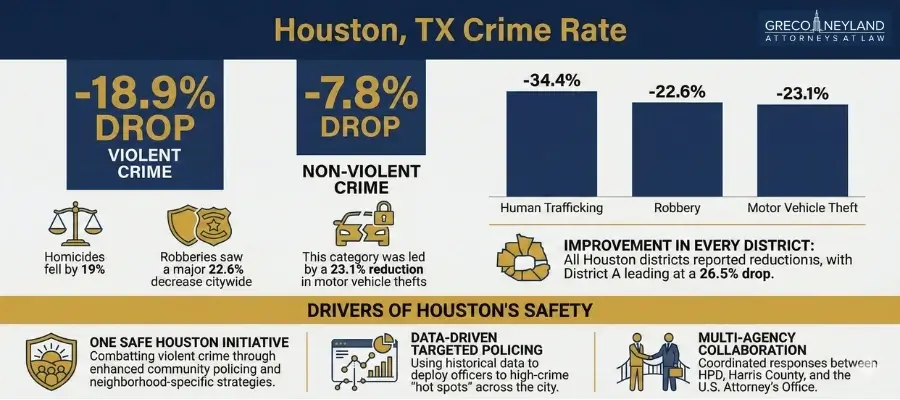
In 2025, violent crime volume fell 18.9%, and non-violent crime volume fell 7.8% in Houston. Information on specific crime volumes for 2025 and how they relate to the 2024 volumes includes:
- 268 homicides, a 19.0% decrease
- 1,380 sexual assaults, a 19.9% decrease
- 4,983 robberies, a 22.6% decrease
- 15,306 aggravated assaults, a 17.6% decrease
- 367 kidnappings, a 10.5% decrease
- 63 human trafficking cases, a 34.4% decrease
- 12,890 motor vehicle thefts, a 23.1% decrease
- 11,255 burglaries, a 16.9% decrease
- 36,772 thefts, a 5.0% increase
Across every category, Houston had significant decreases, except in the non-violent theft category. Each district also had significant decreases from 2024 to 2025, including:
- District A. Violent crime reduced by 26.5%, and non-violent crime reduced by 17.8%.
- District B. Violent crime reduced by 19.8%, and non-violent crime reduced by 15.4%.
- District C. Violent crime reduced by 14.8%, and non-violent crime reduced by 6.4%.
- District D. Violent crime reduced by 12.6%, and non-violent crime reduced by 8.7%.
- District E. Violent crime reduced by 22.7%, and non-violent crime reduced by 17.1%.
- District F. Violent crime reduced by 15.1%, and non-violent crime reduced by 0.5%.
- District G. Violent crime reduced by 15.0%, and non-violent crime reduced by 8.5%.
- District H. Violent crime reduced by 17.8%, and non-violent crime reduced by 12.9%.
- District I. Violent crime reduced by 19.9%, and non-violent crime reduced by 7.0%.
- District J. Violent crime reduced by 25.6%, and non-violent crime reduced by 13.9%.
- District K. Violent crime reduced by 21.2%, and non-violent crime reduced by 10.7%.
During 2024, Houston was home to nearly 2.4 million residents. As Texas’s largest city, decreases in crime volume have a significant impact on the overall crime rates for Harris County and for the state as a whole.
Causes of Crime Rate Decreases in Houston
Seeing decreases in crime rates in Houston and cities across Texas point to initiatives aimed at addressing the root causes of crime. These initiatives include:
- One Safe Houston Initiative: Introduced in 2022, this initiative sought to combat rising violent crime rates through enhanced community policing and other strategies to reduce violent crime.
- Targeted policing: The Houston Police Department used historical data to identify high-crime hot spots and responded by deploying additional officers to the streets.
- Targeting recidivism: The Texas Repeat Offender Program was implemented in 2025 and focused resources on local and state law enforcement efforts to combat recidivists.
- Community investments: Strategies were initiated in specific neighborhoods to improve mental health services, increase street lighting, and create community-building organizations, with the goal of improving residents’ quality of life.
- Increased collaboration: Efforts to improve communication among the Houston Police Department, Harris County law enforcement agencies, and the U.S. Attorney’s Office enable more coordinated crime responses.
Implications of Crime Rates in Houston
Crime rates can have a range of implications for both individuals and communities. This data can affect various areas of everyday life. Addressing crime rates often requires a multifaceted approach, including community engagement, economic development, effective law enforcement, and social services to address underlying issues. Below is a list of key areas of life that are affected by crime rates:
- Public Safety and Health: High crime rates can lead to increased fear and anxiety among residents, impacting their mental and physical health. They can also strain emergency services and healthcare systems.
- Economics: Crime also has an impact on local economies by deterring investment and tourism. It can also increase costs related to law enforcement, criminal justice processes, and insurance premiums.
- Social Cohesion: Elevated crime rates have the power to erode trust within communities and between residents and local authorities. It can lead to social fragmentation and decreased community engagement.
- Housing and Property Values: Crime can lead to lower property values and decreased desirability of neighborhoods, which can further exacerbate economic and social issues.
- Long-Term Development: Local crime rates can also hinder long-term community development and stability. It can affect everything from infrastructure development to social services and overall quality of life.
- Policy and Law Enforcement: Higher crime rates often can lead to increased law enforcement presence and potentially stricter policies. This can have both positive and negative effects on community relations and the effectiveness of crime prevention strategies.
- Education and Youth: Areas with high crime often see negative impacts on schools and educational outcomes. Youth may be more likely to experience disruptions in their education or to become involved in criminal activities.
FAQs
Where Does the Most Crime Occur in Houston, Texas?
Where most crime occurs in Houston, Texas, it is typically in private residences, as reported by the FBI’s Crime Data Explorer. This data shows that 67,577 out of the 137,562 reported violent crime locations were in a residence or home.
The next-largest location where crimes occurred was a category encompassing highways, alleys, streets, and sidewalks, accounting for 23,752 violent crimes.
What Is the Property Crime Rate in Texas?
The total number of property crimes in Texas, as expressed by the FBI’s Crime Data Explorer in 2025, was more than 550,000. Given Texas’s population of more than 31.7 million in 2025, that is a rate of 1,759.7 per 100,000 population.
The FBI’s Crime Data Explorer looks at the index property crimes of arson, burglary, larceny-theft, and motor vehicle theft.
Are Local Crime Rates and Statistics Actually Accurate?
Local crime statistics are generally accurate, but several factors can influence their reliability. It is important to note that not all crimes are consistently reported or recorded by law enforcement agencies, so some crimes may not be included in these data.
Data submission may be incomplete or delayed, affecting overall accuracy. It is important to use crime rates and statistics as helpful indicators of trends, while noting that not all crimes are accounted for.
How Does a City’s Crime Rate Impact Residents?
A city’s crime rate can impact residents in several ways. A primary way is that high crime rates can lead to increased fear and anxiety to an extent that can impact their quality of life.
Crime can also lower property values, making it more challenging to sell or rent homes in areas with high crime rates. High crime rates can also affect residence insurance costs, business growth and development, and public services.
How Do I Find My City’s Crime Rates?
You can find your city’s crime rates through several methods. These methods include contacting your local police department or visiting its website to obtain crime statistics. Many law enforcement agencies publish annual crime rate reports.
Another method is to review your city’s annual crime reports or use the FBI’s Crime Data Explorer. If you are concerned about your safety or are unsure of how to respond after a crime, contact a trusted local lawyer as soon as possible.
Speak With a Trusted Criminal Defense Lawyer Today
If you are navigating a criminal issue in Houston, Texas, and need legal advice or assistance, reach out to Greco Neyland, PC, as soon as possible. We are here to provide essential support with your legal matter.
By scheduling a consultation, you agree to receive the support and care of a thorough, detailed attorney who is ready to seek justice and stand up for your rights. Don’t wait to contact our team for help today.





 ES
ES